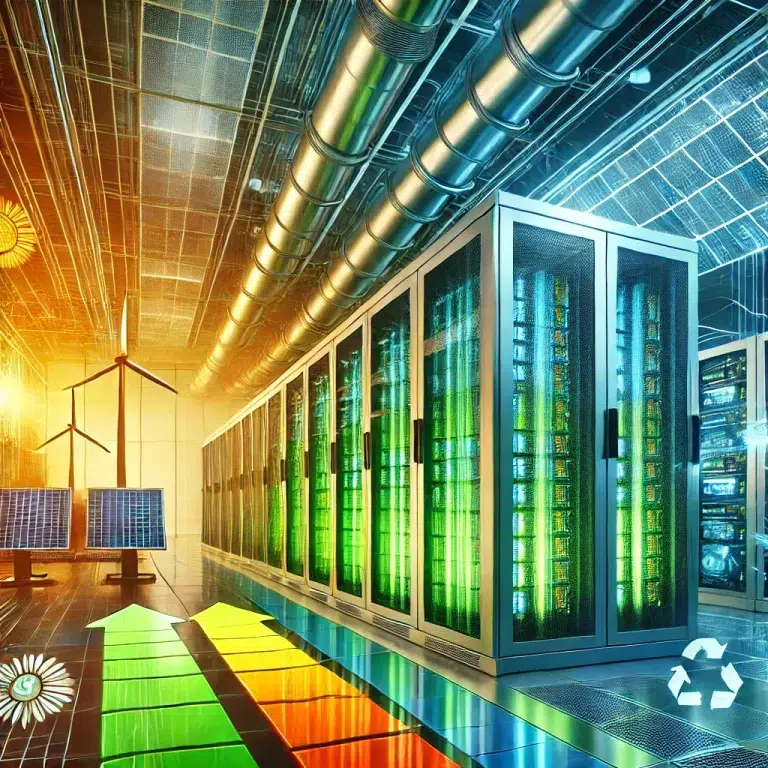
Digitalisation is advancing at an unstoppable pace, and with it the need for more efficient, sustainable and resilient data centres. These infrastructures host a huge number of IT equipment, storage systems and network devices that operate continuously. Keeping them safe requires intensive use of electricity and complex cooling systems. As a result, energy consumption is high and directly affects availability, budgets and environmental impact.
Optimising energy consumption in a data centre does not simply mean reducing consumption, but doing so efficiently, maintaining service levels, security and air quality. The optimisation of a data centre involves action on several layers, from thermal design and air treatment to daily operation, energy procurement and the integration of renewables. When these layers are coordinated, the outcome is lower costs, a reduced footprint and greater competitiveness.
The importance of understanding and managing energy costs in data centres
The starting point for optimisation is understanding the components of energy costs. In a typical facility, around half of the expenditure is associated with IT equipment (servers, storage, networks) and the other half with support infrastructure, with cooling carrying special weight. This balance varies according to rack density, the age of the installation, workload profiles and redundancy strategy, but it highlights a clear idea: every kilowatt avoided as heat is a kilowatt not required for removal.
Beyond kilowatt hours, it is also necessary to analyse tariff structures: capacity charges, reactive power penalties, time-of-use bands, dynamic prices and contractual conditions. In regions with highly seasonal data centre operations, the difference between peak and off-peak hours may dictate the scheduling of non-critical loads such as backups. Defining a baseline consumption and setting an energy budget per room, row and rack allows investments with measurable returns to be prioritised.
Cost management also demands visibility. A well-configured DCIM or BMS consolidates metrics (PUE, supply and return temperatures, pressures, humidity, IT loads, UPS status, alarms) and enables proactive monitoring. Linking this information with the energy purchasing system and maintenance plan helps improve efficiency continuously. Finally, governance should align Facilities, IT and Finance: without this coordination, any attempt at data centre energy optimisation falls short.
At BERRADE we are Data Centre specialists and support clients in defining cost models and savings roadmaps suited to their operational reality.
Energy consumption in data centres
The energy consumption of a data centre is distributed across three main blocks: IT equipment, cooling and auxiliary infrastructure (UPS, distribution, lighting, security). In many environments, IT and cooling may each account for around 40%, leaving 20% for auxiliaries. This picture is not static: workload consolidation, adoption of flash storage or increased rack density alter the thermal profile and thus the demand for cooling.
In cooling, the factors most conditioning consumption are supply temperature, control of ΔT (difference between inlet and outlet air), airflow management and the degree of separation between hot and cold aisles. A low ΔT often signals unwanted mixing, which forces units to work harder to achieve the same heat removal. Adjusting air treatment and sealing leaks (through-floors, blanking panels, raised floor openings) helps optimise consumption without compromising stability.
Water is another key vector. Water efficiency is increasingly measured, as certain evaporative systems can consume thousands of litres annually. Monitoring WUE (Water Usage Effectiveness), adopting closed-loop technologies and tailoring adiabatic strategies to local climate conditions enable reduced consumption of water and limit associated impact. In parallel, it is necessary to assess the indirect footprint of the regional energy mix: the same kWh demand may mean different CO₂ impact depending on time of day and source.
When speaking of the ideal data centre, it is not a single model but a set of better choices like modular design, adequate densities, well-managed cabling that does not block airflow, intelligent fan control, economisers where climate allows and reasonable integration of renewables. This convergence is what truly reduces consumption and stabilises PUE over the year.
Best practices o pave the path towards the ideal data centre
The path towards the ideal data centre is travelled by applying best practices consistently. There is no silver bullet, but rather a sum of decisions: correct thermal design, temperature management, data-driven data centre operations, automation, and a range of solutions that make it possible to optimise consumption.
Free cooling
Free cooling uses favourable outdoor conditions to remove heat without continuous mechanical compression. It can be implemented directly (bringing in filtered outdoor air) or indirectly (exchanging heat via plates, enthalpy wheels or adiabatic units). In temperate climates, a well-designed system can cover a significant percentage of annual cooling hours with outside air, thus reducing energy consumption and lowering seasonal PUE.
For effective operation, robust control sequences are vital with enabling criteria based on temperature and humidity, alarms for particles or pollution events, and coordination with internal temperature management to avoid stratification. In white/grey space layouts, free cooling can be combined with aisle containment and variable speed fans, adjusting airflow to the real heat dissipated by IT equipment. An airflow audit (measurements and, if required, CFD) helps identify bottlenecks and best practice sealing.
Temperature management
Temperature management does not mean simply keeping the facility “cold”, but operating within safe ranges for electronics while optimising consumption linked to cooling. In practice this means monitoring ΔT rack by rack, tuning setpoints and airflows, and avoiding bypass air. Working with TA/TS (air inlet/outlet temperatures) and differential pressures by aisle enables unwanted mixing to be detected. Blanking panels, overhead containment, raised floor perforations sized correctly and rational distribution are best practices that improve efficiency at low cost.
Another front is fan speed. Configuring control laws based on real server inlet temperature, and not just CRAC/CRAH return air, avoids over-supply and noise. In high-density environments, row-based cooling units or rear-door exchangers can remove heat efficiently at source. In HPC scenarios, direct-to-chip liquid cooling or immersion cooling systems handle critical loads that would otherwise demand excessive airflow. All this discipline of data centre thermal optimisation is linked to the reference article on data centre thermal optimisation.
Artificial intelligence and machine learning
The application of AI and machine learning in energy management is already in production at numerous operators. A well-trained model leverages DCIM/BMS data (supply and return temperatures, setpoints, flows, rack occupation, IT load, UPS status, outdoor conditions) to recommend or implement fine adjustments that reduce cooling consumption. In some cases, reductions of up to 40% in cooling energy use have been reported.
AI also provides further best practices: early detection of anomalies (a fan losing efficiency, a clogged filter), estimation of energy costs from setpoint changes, prioritisation of non-critical jobs at lower-cost hours, or selection of the most efficient air system given the combination of external temperature and humidity. Integrated with workload orchestrators, AI can shift tasks and optimise consumption without affecting SLA. The result is a more stable, predictable and efficient data centre.
Renewable energy
The integration of renewable energy is another best practice of the ideal data centre. Several routes exist like photovoltaic self-consumption, medium- or long-term PPAs (Power Purchase Agreements) with guarantees of origin, battery storage for peak shaving, and participation in demand response programmes. These mechanisms lower costs over time and reduce carbon footprint.
To deliver real value, renewables must be orchestrated with data centre operations. From planning maintenance in hours of highest solar output, to discharging batteries during price peaks, or leveraging modern UPS capabilities as grid resources (where regulation allows). With proper management, renewable energy becomes another lever to optimise consumption and stabilise the cost per kWh. At BERRADE, these options are evaluated within a range of modular solutions, and our teams integrate them from the design stage where feasible.
FAQs
How can energy consumption be reduced in a data centre?
The recipe combines best practice operations and design choices.
In the short term, sealing air leaks, installing blanking panels, tuning setpoints and fan speeds, maintaining filters, and checking raised floor airflow. Consolidating workloads and virtualising servers also helps, shutting down hosts when demand is low.
In the medium term, adopting free cooling, deploying row-based or liquid cooling systems in high-density areas, and implementing advanced control algorithms to optimise cooling consumption.
In the long term, integrating renewables, signing PPAs and modernising electrical and UPS equipment to higher-efficiency models.
To understand and track improvements, it is essential to know how to calculate energy efficiency in data centres and translate these metrics into investment decisions.
What is PUE and why is it important to measure it?
PUE (Power Usage Effectiveness) is the ratio between the total energy consumed by the facility and that used by IT equipment. The closer to 1, the less energy is consumed by support functions (cooling, electrical losses, lighting). Measuring it continuously, by periods and by rooms, helps detect drifts (for example, an increase in cooling energy consumption at night or excessive energy use in a specific zone) and prioritise action. Correctly interpreted, it guides effort and lowers costs.
How much water do these centres consume and how is it managed?
It depends on the technology installed and the operational strategy. With evaporative towers or intensive adiabatic systems, water consumption can be high (thousands of litres of water per year). To reduce water use without losing cooling capacity, closed loops, precise thermal approaches, modulated adiabatic strategies and WUE monitoring are recommended. Integrating water quality sensors and preventive maintenance avoids overdosing and losses.
Modern data centre optimisation already considers the energy–water binomial.
What factors really influence data centre energy consumption?
The main drivers are IT equipment density and load profile; efficiency of the electrical chain (transformers, UPS, distribution); the architecture and control of cooling systems; airflow design (containment, air treatment, sealing); external climate; and operational maturity (monitoring, procedures, automation level).
The right combination of these elements optimises consumption, stabilises PUE and makes the facility more competitive.
In conclusion
Data centre energy optimisation is not a one-off project but a continuous process fuelled by data and regular reviews. It starts with proper measurement, realistic goals and prioritisation of actions with return: sealing and airflow, temperature management, free cooling, AI control, and, when maturity allows, integration of renewables.
Following this sequence, facilities reduce consumption, improve efficiency and lower costs without compromising availability.
BERRADE’s teams offer modular solutions aligned with this approach. We assess each site, propose a range of options that balance investment and savings, and oversee implementation to ensure improvements are reflected in both operational and financial metrics.
From our experience, a data centre evolves into the ideal facility step by step, guided by technical expertise and a clear business vision.