What is a closed rack?
A closed rack is a metal cabinet designed to house and protect technological equipment such as servers, routers, switches, or uninterruptible power supply (UPS) systems. Unlike open racks, the design of these enclosures allows for stricter control of the internal environment, offering clear advantages in terms of security, cable organisation, thermal insulation, and protection against external factors such as dust, humidity, or acts of vandalism.
These racks are manufactured in various sizes and configurations to adapt to every need, whether in offices, data centres, industrial facilities, or outdoor environments. Their versatility makes them a key solution for keeping critical technological systems operational.
Differences and advantages over an open rack
While an open rack exposes equipment to the environment, facilitating access but sacrificing security and protection, a closed rack offers a significantly more controlled environment. Here are its main advantages:
| FEATURE | OPEN RACK | CLOSED RACK |
|---|---|---|
| Physical access | Easy access without barriers | Restricted access via locks |
| Security | Low | High, especially with electronic locks (more about rack security features) |
| Environmental protection | None | High (IP55, IP65) |
| Cable organisation | Limited | Better integrated |
| Thermal control | Environment-dependent | Prepared for active/passive ventilation or cooling |
In addition to these technical advantages, closed racks improve aesthetics and reduce noise, which is particularly valued in offices and shared spaces.
Uses of closed racks
Closed racks are used across multiple sectors, depending on the type of equipment they house and the environment in which they need to operate. Their flexibility makes them indispensable:
- Telecommunications: They protect nodes, switches, and network equipment both indoors and in fibre optic to the home (FTTH) deployments. Learn more about telecommunications enclosures.
- Energy: They house control, communications, and monitoring systems in substations or renewable energy installations.
- Transport: They safeguard signalling, video surveillance, and critical communications equipment in railway or road infrastructure.
- Offices and Data Centres: They centralise cabling and active equipment with security, order, and ventilation.
In all cases, the closed rack ensures service availability and extends the lifespan of housed devices, thereby protecting your investment. In our blog, you’ll find guidance on how to choose secure telecom cabinets based on your specific needs.
Some examples of closed rack cabinets
Next, we explore the two most common types of closed racks and their practical applications.
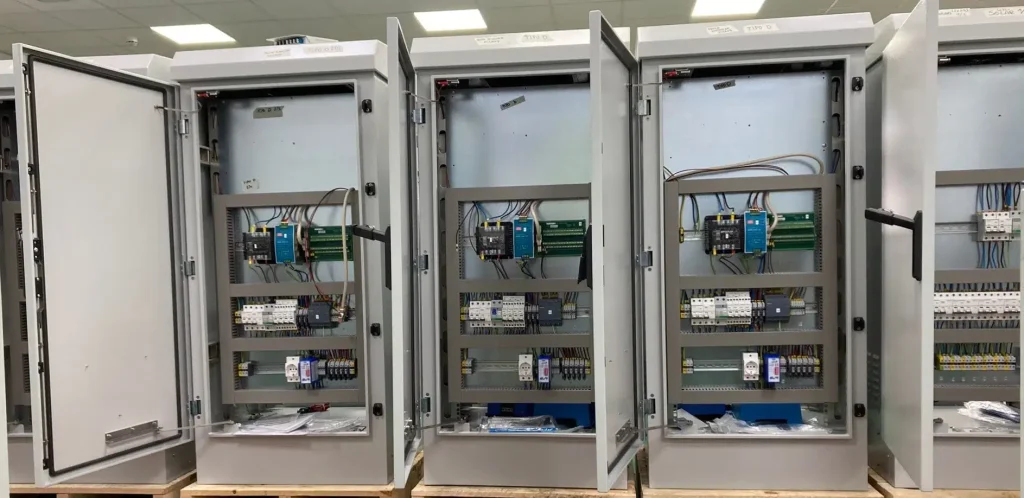
Floor-standing closed rack
This type of cabinet is designed to be installed directly on the floor. It’s used in environments where numerous pieces of equipment need to be housed and there’s sufficient space. It typically has a capacity of between 27U and 47U and is common in technical rooms, data centres, or industrial facilities.
Some of its most outstanding features:
- Prepared for active ventilation or cooling.
- Compatible with pull-out trays, power supply systems, and customised internal organisation.
- Option to include wheels or levellers.
- Can be manufactured with IP65 protection for outdoor use or aggressive environments.
At BERRADE, we design floor-standing closed racks that are robust and modular, offering different levels of protection and finishes tailored to each environment. Additionally, depending on the installation environment, we work with aluminium or galvanised steel structures (download our catalogue to see the advantages over hot-dip galvanised iron and other materials). This allows us to balance weight, mechanical strength, and corrosion resistance.
Wall-mounted closed rack
Wall-mounted racks are installed directly on a wall and are designed for indoor environments where space is limited. They are common in office network points, classrooms, small installations, or areas where large load capacity isn’t required.
Some of their key advantages include:
- They take up little space.
- They allow convenient access to the equipment.
- They often include basic ventilation options.
At BERRADE, we don’t manufacture wall-mounted racks, but we do collaborate closely with our clients to integrate them into larger systems or mixed solutions. Our focus is on floor-standing closed racks with high levels of protection and performance, but we always provide expert technical advice to ensure perfect compatibility between all elements of your installation.
Experts in custom closed rack solutions
The true value of a closed rack lies not only in its metal structure but in its ability to adapt to real environmental conditions and the specific needs of each client. That’s why at BERRADE we develop tailor-made solutions for the most demanding projects in telecommunications, energy, and transportation sectors.
Every project is unique and requires a personalised approach. Some cabinets need passive ventilation, others demand active cooling systems (such as free cooling), and outdoor installations must withstand rain, dust, and impacts. For these cases, we design closed racks with IP65 protection, ensuring watertightness and exceptional durability.
Even in urban environments where aesthetics matter, we pay close attention to design details, materials, finishes, and assembly to deliver racks that are functional, secure, long-lasting, and visually integrated.
Are you looking for a closed rack tailored to your installation that guarantees the protection of your equipment?
Our technical team supports you at every step to ensure uninterrupted service in critical environments, meeting the highest standards.